
ABSTRACT “The Missing Gesture” is a preview of a chapter from the upcoming book, Reimagining the Body by Rolf Movement® instructor Aline Newton. Newton is a long-time student of Hubert Godard and presents teachings from his style of movement education. The discussion starts with a case study of an arm injury. The nuance of the expressive gesture is discussed and compared with instrumental movements.
Editor's note: As mentioned in the abstract, this article is an excerpt from Aline Newton's upcoming book Reimagining the Body. It features translated quotes in italics by Hubert Godard from workshop lectures that Newton attended. They are printed with permission. Hubert Godard is a Certified Rolfer, a dancer, and a researcher who lives and practices in France; as a manual practitioner, movement practitioner, and theoretician, he has been a primary influence on the development of Rolf Movement since 1990. He is well known for his tonic function model; he has an inspiring and insightful way of teaching movement and manual therapy. Some modifications to this book excerpt have been made to fit the style of this journal.
Working with Rhea
Rhea was a cellist who came to me for a Rolf Movement Integration session by referral from another musician. Five years earlier, while riding her bike, a dog ran in front of her and she fell off, bracing herself with her left arm to protect her head. She broke her elbow in three places and her humerus had a hairline fracture. She did intensive physical therapy for a year and was able to get back to playing but when she came to see me, five years later, she was still experiencing pain in her arm and increasing stiffness. She was also feeling back stiffness and had a bunion on the left foot. From my point of view, watching her walk, the whole left side had a diminished quality of movement.
I invited her to lie on the table on her back, including some remarks about keeping a big frame of perception. I coached her to feel her head resting on the pillow because when she was sitting and using her arms, I noticed her head position and how her way of holding her axis, or ‘center line’, restricted the arm movement. As her head rested back on the pillow, she mentioned being reminded of how she loved to float in the ocean – the feeling of support.
I put my hand under hers and asked her to feel through her hand to mine underneath it, and I invited her to follow my hand sliding towards the foot end of the table. Then I asked her to feel the table with the inside of her elbow and to let her elbow come out towards me.
Yes, these movements helped me to investigate the range of motion of the shoulder, but there is more to it. I didn’t think to myself: “I’m evaluating a shoulder joint’s mobility.” In my touch, I’m touching Rhea, as if I am touching her whole body at once. I am meeting a whole system, a whole person. This benefits me too: the quality of touch is one that helps my own hand/arm/shoulder find the most stability. I keep my attention peripheral, listening. I remember Hubert Godard saying:
This way, the good coordination can come ‘exogenously’ [from the outside]. It’s not a biomechanical question, in the end, it’s a relational question. Why with the arm? Because the arm is a transitional organ. It is built in the transitivity; it doesn’t exist by itself.
Trying to explain what I mean or what Hubert meant by “the arm is a transitional organ” would not work for this session, but I did suggest to Rhea that the hand is organized by the world and the arm connects us to each other.
Somehow her physical complaint made more sense when she was able to connect it to a movement in the present and her emotional experience of the past. The whole process opened up new possibilities for her.
With my hand still under hers, I had her start the movement with her arm extended and connected to me. I suggested she begin a small twist with her arm, rotating away from me. I remember that she said she was imagining scar tissue growing in the space between her shoulder and her chest, and this restricted her movement. She asked me if the tissue needed to stretch – the mechanical view of the body. I encouraged the contact between our two hands, and then all of a sudden there were tears in her eyes – not because the movement hurt, but because something emotional welled up. This was not a memory ‘stored’ in the body. It was about reclaiming a possibility, the missing gesture – in this case, the sense of contact. Hubert credits François Delsarte (1811-1871) with calling the shoulder ‘the thermometer of emotion’ (Stebbins 1886).
Rhea’s tears, she said, had to do with feeling so alone during the time of her injury, as a single parent of two children who were quite young at that time. She was trying to stifle the tears, though I reassured her (for the cortex’s reasoning ears) that tears release stress hormones. Though not seeking it out in particular, it is very common for a small moment of release to arise when a pattern is changing. The emotion is almost a reflection of the missing gesture – reaching out in longing, receiving contact – what was not done, not expressed at the time. Hubert sometimes would call this welling up the ‘petit emotion’. It is a moment that allows integration and movement, not at all the old model of catharsis. Rhea was surprised at her response, and very relieved, she said. Somehow her physical complaint made more sense when she was able to connect it to a movement in the present and her emotional experience of the past. The whole process opened up new possibilities for her.
To end the session, I asked Rhea to come to standing, finding ease through the feet. When I tried the approach of giving some support to her head, she stiffened up. So instead, taking my cue from her responses, I suggested coming back to the feeling of the ocean around her, even in standing – the image of support that she had offered me at the beginning of the session.
I met Rhea only that one time when she passed through Boston. Her session is a good example of the power of understanding the missing gesture. By starting from her physical injury and inviting a simple movement – opening – along with the contact with me, she was able to reclaim the gesture of reaching, to feel the yearning from the time five years before when the problems began. The missing gesture was crucial for bringing movement to the stiffened area, but was not recognized as a necessary part of rehabilitation until our session.
Expressive Gesture
Imagine a picture of someone extending their arms in supplication, or a little child reaching up to a loved one, or someone pointing to show someone else, “Look!” All these gestures are an expression; they communicate a feeling, an interest, a shared perception, a relationship. This is part of what Hubert meant when he called the arm a ‘transitional organ’.
Yet, if any of us experiences tension or pain or lack of flexibility in our arms and shoulders, it is immediately the mechanical aspect – muscles, joints, etc. – that comes to mind. To manage these problems, strengthening, stretching, and surgical procedures are the go-to solutions.
The movement of our arms in gestures of expression is intimately connected with the function of the shoulder, elbow, wrist joints, and hands. The way I touch or don’t, the gestures that I allow or don’t, immediately impact the stability of the shoulder. We could think about our pain at least in part as a problem of expressive gesture just as much as mechanical overuse. When I am working with a person, as with Rhea’s session, I bear Hubert’s perspective in mind.
The expressive quality of arms is also a matter of personal significance to me. In the Rolfing® Structural Integration (SI) pretraining, “Perceptual Body,”1 we were videotaped walking towards the camera, introducing ourselves, turning, and walking away. At twenty-one years old, this was the first time I had seen myself on camera this way – in 1981 we were not used to seeing ourselves all the time! I was shocked at the sight of my arms, hanging limply by my sides. Was it the result of many years of training not to touch the antiques in my childhood home for fear of breaking something? Being told not to hang on people? A way of hiding? There may be many elements behind the shape I saw. Hubert is the only teacher I have met who stresses the key place of arms in our posture. Most approaches assume that the body is built from the ground up, like any other structure. ‘Grounding’ and ‘rooting’ are powerful images that represent important functions. But an often-disregarded dimension of finding the ground has to do with what lets go from above. The pattern of holding in the shoulders and arms has to begin to let go for us to be able to find grounding, just as much as the other way around. And often the shoulder pattern has to free up first, or it prevents anything else from changing.
The significance of the movements of our hands and arms goes deep; babies have a grasp reflex, an inheritance from when holding mom’s fur was key to survival.
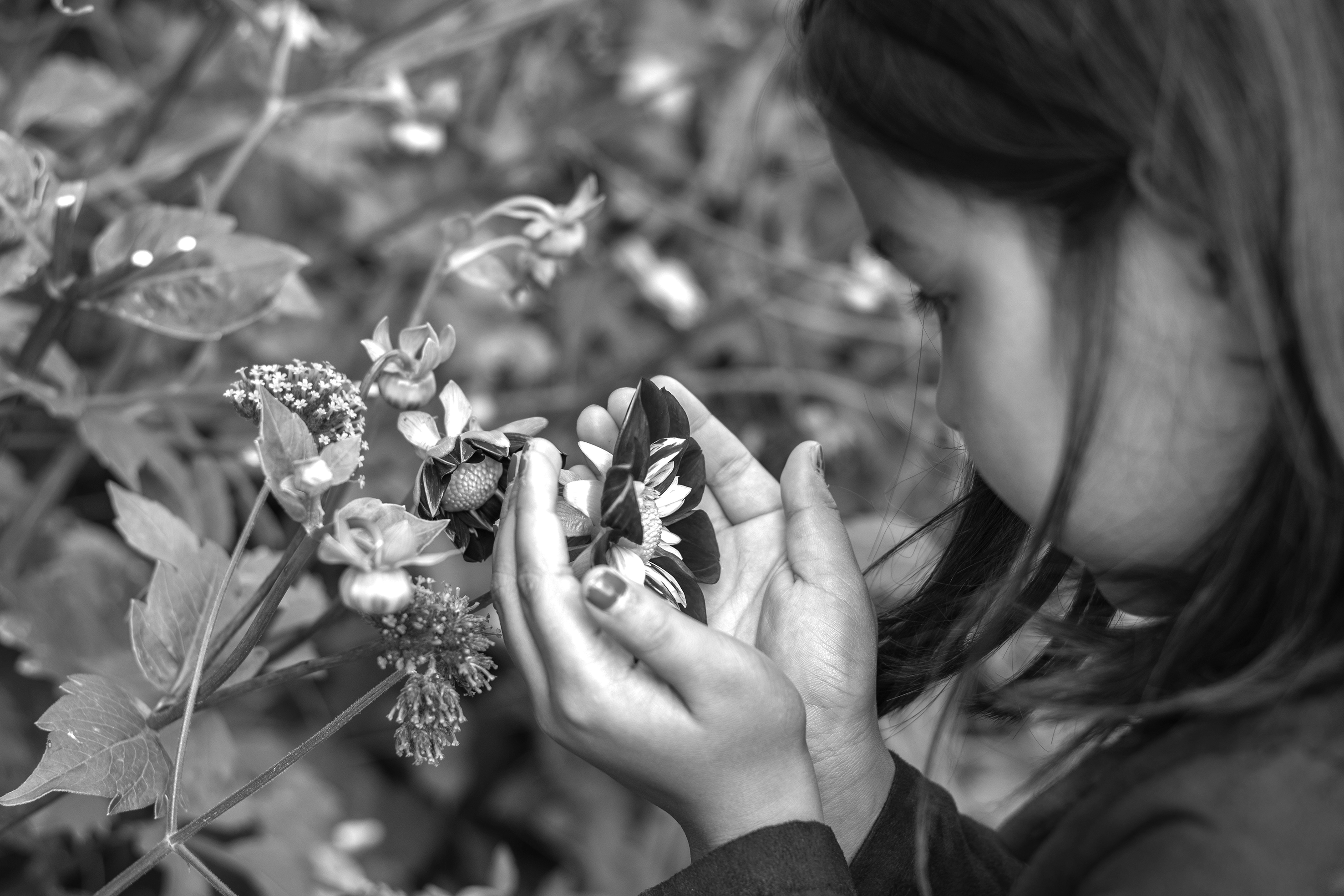
The significance of the movements of our hands and arms goes deep; babies have a grasp reflex, an inheritance from when holding mom’s fur was key to survival. Babies begin to reach for things before they can even sit on their own. Long before infants manage to sit up or walk independently, patterns of reaching for loved ones and objects, as well as patterns of pulling and pushing away, have been established and these patterns will be there when the child stands up. For all of us, the expressiveness of the arms, or lack thereof, is inevitably going to be connected to posture, and to others. Transitive
arms are formed in relationship to an other.
Hubert was fond of pointing out that in the shoulder joint, the socket for the humerus is very shallow compared to the hip joint. Rather than being primarily stabilized by thick ligaments the way the femur is in the hip socket, the shoulder’s integrity is maintained, in great part, by the muscles called the ‘rotator cuff’. And muscles are under the sway of our arousal system through the gamma motor neurons/gamma loop.2 This translates into the arms and shoulders being a thermometer – responding to and reflecting our moment-to-moment emotional state, and to the longer-term patterns we call ‘attitude’. They don’t release once and for all. Instead we can use the arms’ expressive quality as a doorway for practice.
In Practice
From the first few workshops with Hubert, he emphasized the importance of our hands and arms in expression and in relating us to our surroundings. He had us work with a stick, about the size of a closet dowel. Lying on our backs, the stick in our hands, he would say to the class:
First, let yourself notice where you and the stick are touching. Notice the place of contact – it is a two-way process: you are touching the stick and being touched by the stick at the same time.
With this quality of contact, the stick floated up, taking one joint of the upper limb at a time – only the palms, then the carpal bones, then wrists, then radius, then ulna, then each humerus, then each scapula – each joint articulating between ground and sky. Touching the stick and letting in the touch of the stick changed so much in my physical experience. Instead of grasping, there was contact, a meeting that continued to be a process of discovery, never resolving into the known and expected.
In a modified sun salutation with our hands on a chair, Hubert engaged us in practices that involved working with mechanical and expressive qualities simultaneously: we explored how we met the surfaces we contacted, how we were able or not to expand into the surrounding space. He never asked us to “raise our arms” – it was always with an imaginative framing – as if we had our best friends on either side and we were reaching for them; or projecting out into the space far away, or as I mentioned before, greeting the sun.
He would tell us:
These muscles are also the defense of territory, (it’s not nothing!) I can push away, and I can say no, or I can’t say no; once you have found the way to organize the core, you have a lot of strength. When you have that force, even a fragile person can push. It’s a new experience and there will often be a vagal response.
This is what is behind Hubert’s cryptic saying that the arms are transitive. Go-betweens. They are often telling a story. It could be important to be in conversation with clients, while we work together, to give people space to let me know their associations or what is coming up. But even without that, it’s important to bear the arms’ complexity in mind.
In working this way, there is at the very same time a physical impact and a change on another level. The muscles do get stronger; coordination and balance do improve. But these changes are a consequence or at least go together with a change in the other layers of perception, body image, expression, and symbolic gesture.
In the model where muscles are given the primary importance, a person might be told to strengthen the serratus anterior muscle, the primary stabilizer of the shoulder blade. Sometimes, a little bodybuilding of specific muscles is useful; the movements involved in waking up serratus anterior bring about a kinesthetic change. This reintroduces the option of recruiting those particular fibers. Like musicians in an orchestra at the ready, they are available to play the kinetic melody. But reclaiming the potential of action is far more than serratus anterior, triceps, or any other muscle. What is reclaimed is a sense of action possible in an environment.
When I was working with Rhea, it was the quality of contact, what Hubert calls ‘haptic capacity’, that helped my own shoulder blade to be stabilized. If I had been touching Rhea with distaste, or in a more objectifying way, rather than from the hand’s contact helping to recruit serratus anterior fibers, I would be more likely to trigger the large forearm muscles in a grasp, with no give and take in the hand itself. And serratus would miss its chance: instead, pectoralis minor would probably have worked first, pulling the shoulder blade out of its optimum mechanical position for stability.
I am going into the details to show that our attitudes cannot be separated from our mechanics. Mechanics express an attitude, they manifest it. Not just a personal one, but one that is imbued with cultural overlay. They are at once our most personal expression, and a reflection of our society.
“Throwing like a Girl” (Young 1980)
There is a long history of the significance of gesture, Hubert explained. The classic example is in the movement of throwing: seventy percent of women cannot throw. Instead they in a sense push the ball, with no rotation of the trunk or leaning back. This was noticed already a hundred years ago, so there are many studies on it. One of the most well-known is the one from a feminist point of view, in American political theorist Iris Marion Young’s essay, “Throwing like a girl” (1980).
Hubert paraphrased French philosopher Simone de Beauvoir: you are not born a woman, you become one. The fact that many women don’t automatically find the gesture of throwing has nothing to do with physiology; it is a social mold that is imposed from the outside. Published in 1980, Young’s text continues to have a huge influence. It is remarkable that something as seemingly innocuous as throwing a ball – such a basic movement – could from an early age affect a girl’s sense of self, of possibilities.
In my normal life, I never punch. I rarely have a reason to make a fist. At first, it really did feel forbidden. At the end of the sessions, I felt like Marlon Brando, or the male fashion models, with the strong arms Hubert had described.
Hubert told us:
Fashion models, on the catwalk, are a good example. The male models walk with strong arms (think actor Marlon Brando), rotated internally, like a gorilla. In the women you see that both the teres majors, which run between the shoulder blade and the humerus, are systematically blocked in external rotation. They are not free to move in a punching or throwing manner. The implication is that the gesture that is blocked is the phallic gesture, to penetrate the space. In fashion models it is almost a caricature. You can see why Ida Rolf [sic] insisted on arms that were in internal rotation. She was living at a time when it wasn’t so easy to be a woman in a university setting. So it’s a lot: when you put the shoulder girdle back on its axis, you open the possibility of new gestures and new capacities of expression.
Tai Chi Arms
I can attest to this. Early in my work with Hubert, a colleague offered a portrayal of my arms as geworfen – flung into the world, limp and passive, as I described before. These days, Hubert’s ideas come back to me regularly in my practice of tai chi. What actions are permitted and which are forbidden or avoided? How does that connect to the freedom of hands, arms, and shoulders in movements? To our posture and balance? All these themes are present.
My tai chi teacher, Don Miller, does not teach a form of twenty-four or any number. His approach is “Essential Moves.” I think of the practices as variations on a theme. Take the basic movements of ‘grasp sparrow’s tail’ for example, translated as ward off, rollback, press, and push. Each one is an expression of a particular quality. Ward off is a way of expanding into self-protection. Rollback is release without collapse. Press can be more like condensation, becoming more dense, rather than fear, tension, or aggression. And push can bring in all those qualities for strength without effortful contraction. It is a practice of transformation. And of course, being able to maintain a connection with heaven and earth, what Don calls ‘rooting’ and ‘rising’, has to be included in each gesture. The basic premovement is this capacity to orient to the ground and the sky, I have been working with this for years. The capacity to not fall down, while exploring new gestures. The other qualities in grasp sparrow’s tail could also be called premovement. Don’s form of tai chi is a beautiful expression of Hubert’s understanding of movement.
Expressive gestures have something to do with language and they have something to do with mind. It is as if the gestures are a part of language – language is movement, both are expressive; they are inherently related and inherently different from pragmatic, deliberate, controlled gestures.
Don likes to bring in even more unique qualities: we can use free flow and fling our arms in each gesture, and then do the moves with bound flow, carefully carving each moment, agonists and antagonists engaged. We can emphasize the dragon, the spiraling quality of the hands, limbs, spine, folding, and twisting inwards and outwards. And sometimes we do all the gestures with fists – tai chi fists – which spiral in and don’t engage a big biceps contraction.
I find that the practice of varying the arms’ quality leads to better orientation, freeing the central axis, the spine, or in the image from tai chi, the strand of pearls hanging from the sky. It is the variation that leads to a strong central line. With so many transformations, the arms have to let go of any postural activity. Then the sense of two directions, extending beyond the head, beyond the floor provides the necessary stability. And in addition, I am invited into the domain of missing gestures.
Hubert’s words come back to me:
When you succeed in opening the core stabilization and the capacity to push, then there’s a feeling that comes up, a strength. The social sphere does impose body image, and to give back another dimension, it is clear that you will have an effect on the autonomic nervous system.
In my normal life, I never punch. I rarely have a reason to make a fist. At first, it really did feel forbidden. At the end of the sessions, I felt like Marlon Brando, or the male fashion models, with the strong arms Hubert had described. The thought is, “Very unladylike.” Luckily, I have practice with allowing those thoughts and the associated feelings. The autonomic nervous system gets activated – sweating, heat rising, and sometimes trembling. The energy spent in avoiding certain gestures begins to move. A small emotional charge arises as the gestures unconsciously forbidden are finally allowed.
These muscles are also the defense of territory, (it’s not nothing!) I can push away, and I can say no, or I can’t say no; once you have found the way to organize the core, you have a lot of strength. When you have that force, even a fragile person can push. It’s a new experience and there will often be a vagal response.
It’s not nothing! As Hubert described it, reclaiming gestures is reclaiming possible actions along with their implications. The new possibilities have to be metabolized – what if I enjoy punching? What arises when I feel dangerous?
In tai chi, after each practice, there is a chance to digest the arousal in wu chi, empty standing. Just standing. Feeling the ground and the surrounding space all the way to the sky. The reactivity has a chance to dissolve. Over time the movements are more familiar and even fun. It gives a different meaning to ‘range of motion’, more like ‘range of expression’.
Arms and Expression
Hubert mentioned at a class in Chandolin, Switzerland, in 2008 that there is a difference between what he called instrumental movements – such as lifting weight in an exercise or grasping a pen – and expressive gestures.
American philosopher Shaun Gallagher describes the case of Ian Waterman in his book, How the Body Shapes the Mind (2005). As a result of a virus, Ian no longer received feedback through his proprioceptors below the neck. He had to use vision and an elaborate routine to accomplish any instrumental movement – seemingly simple movements that most of us would take for granted like picking up a cup. Over time, Ian had learned and rehearsed how to control his gestures when telling a story. As long as he could see his hands, he carefully orchestrated their movements to match what he was saying. Gallagher conducted an experiment in which Ian sat in a chair with his hands hidden by a screen. Without vision, normally Ian would not be able to move. Gallagher got him to tell a story and watched as Ian’s hands and arms moved automatically, for the most part as yours or mine would. It was quite a surprise to discover that when in animated conversation, Ian’s hands moved on their own as he was expressing himself. Ian was unaware of what his hands were doing.
Gallagher could see a clear difference in the coordination of the movements without the screen, when they were deliberate and Ian could see them; and when they were natural, when Ian couldn’t see them. When deliberate, the pace of Ian’s speech must slow to match the movements, which are themselves slower. There was more jerkiness and less flow in their organization. Given Ian’s lack of sensory feedback, when the screen hides his hands, it shouldn’t be possible for his movements to happen in an organized way. But that’s what Gallagher saw.
Are expressive gestures fundamentally different from instrumental/practical/pragmatic ones? We do not yet fully understand how this works, and that’s not easy for us. It challenges some givens. As the neuroscientist Michael Graziano, PhD, put it, “any complexity lurking under the surface was like Godzilla hunkering under the surface of the ocean. Something horrible, nightmarish, and revolting was threatening an orderly universe” (2018, 72).
Based on this research with Ian, Gallagher proposed that expressive gesture is linked to language, “that gesture is not a form of instrumental action but a form of expressive action; not a reproduction of an original instrumental behavior but a different kind of action altogether . . . This suggests that it is part of and is controlled by a linguistic/communicative system rather than a motor system” (2005, 117-118).
We don’t know the answer yet. Hubert gave another surprising example: children blind from birth, who therefore have never seen anything at all, still gesture with their hands when they talk – even when they are speaking with someone who is also blind! And without having ever seen anyone else, their gestures still resemble those of a sighted person. The blind children’s expressive gestures support Gallagher’s point. The movements that come from expression may even be generated in a different part of the brain than the instrumental ones.
Gallagher suggests, French philosopher Maurice Merleau-Ponty, PhD (1908-1961), “tells us that language accomplishes thought. It seems quite possible, then, that gesture, as language, assists in that accomplishment. Even if we are not explicitly aware of our gestures, and even in circumstances where they contribute nothing to the communicative process, they may contribute implicitly to the shaping of our cognition . . . Gesture as a language may serve communication with others, but it may at the same time accomplish something within ourselves, capturing or generating meaning that shapes our thoughts” (2005, 122).
Hubert sums all this up when he says, “you need your arm to think.”3
Expressive gestures have something to do with language and they have something to do with mind. It is as if the gestures are a part of language – language is movement, both are expressive; they are inherently related and inherently different from pragmatic, deliberate, controlled gestures. I was reminded of the beautiful movement of the little three-year-old children in a Duncan dancing performance I attended years ago. Rather than instruct them about how to move, the teacher came onto the stage and reached into the pouch attached to her belt. Pulling out a handful of white feathers, she threw them up in the air, and all the children with one breath said, “Ahh,” reaching up in unison to catch the feathers as they floated down – movement as expression and response. When we see our shoulder problems only in terms of mechanics, we miss this whole dimension, which is so important!
Endnotes
“Perceptual Body” was the title of a pretraining workshop in 1981 run by the New York School of Rolfing [SI] with Louis Schultz, Owen James, and Rosemary Feitis.
Gamma motor neurons (also known as ɣ-motoneurones) increase the sensitivity of the muscle spindles to stretch. With the alpha motor neurons (also known as α-motoneurones), they are important components of the stretch reflex. For a more nuanced understanding, see Ribot-Ciscar, Rossi-Durand, and Roll (2000, 271): “Whereas in amphibia, terminal branches of α-motoneurones provide motor innervation to muscle spindles, in mammals, a separate fusimotor supply has evolved, namely ɣ-motoneurones. These are morphologically different from α-motoneurones, they receive different reflex connections, and they innervate muscle spindles separately and more extensively. Together this suggests that the fusimotor system might, to some extent, act independently of the skeletomotor system and could modify muscle spindle sensitivity selectively in order to make the receptors extract more accurate information about movement. The fusimotor system is indeed better thought of as allowing state-dependent parametric adjustments of length and velocity feedback rather than as simply compensating automatically for muscle shortening, a role devoted to the pre-existing skeleton-fusimotor system.”
As already mentioned, the translated quotes of Hubert Godard in this article came from workshop lectures that Aline Newton attended. Additionally, there is also an article of an interview with Hubert Godard on the same subject: "The Missing Gesture." First published as an interview between Godard, Daniel Dobbels, and Claude Rabant in French as "Le Geste Manquant" in Etats de corps, io, no. 5, Ramonville St. Agne, Eres, 1994, pages 63-75, and available from https://bodylab1516.files.wordpress.com/2015/12/le-geste-manquant-hubert-godard.pdf. It is also available translated into English by David Williams in Writings on Dance 15, winter 1996, Victoria, Melbourne, pages 38-47, and can be found at https://hal-univ-paris8.archives-ouvertes.fr/hal-02292248/file/Godard_1994_The missing gesture.pdf.
Aline Newton is a Certified Advanced Rolfer® in private practice in Cambridge, Massachusetts. She served for many years as chair of the board of directors of the Dr. Ida Rolf Institute® (DIRI), as well as being a DIRI faculty member. She holds a bachelor of arts from John Hopkins University and a master’s of arts in education from the University of Toronto. Since 1990 she has studied extensively with Hubert Godard, dancer, Rolfer, and movement educator, and has assisted him in many workshops.
References
Gallagher, Shaun. 2005. How the body shapes the mind. New York, NY: Oxford University Press.
Graziano, Michael. 2018. The spaces between us: A story of neuroscience, evolution, and human nature. New York, NY: Oxford University Press.
Ribot-Ciscar, Edith, Christiane Rossi-Durand, & Jean-Pierre Roll. 2000. Increased muscle spindle sensitivity to movement during reinforcement maneuvers in relaxed human subjects. The Journal of Physiology 523(Pt 1):271-282.
Stebbins, Genevieve. 1886. Delsarte system of dramatic expression. New York, NY: Edgar S. Werner.
Young, Iris Marion. 1980. Throwing like a girl: A phenomenology of feminine body comportment motility and spatiality. Human Studies 3:137-156. ■
View all articles: Articles home
Share this article:


