
ABSTRACT In this edition of Meet My Rolfer™, Mandy Cheek explores Kathy Rooney’s journey into the Rolfing® Structural Integration (SI) profession. She shares a few experiences from the many continuing education courses she has taken along the way, as well as her contributions to her Rolfing business in North Carolina. The conversation highlights Rooney’s dedication to advancing the profession by mentoring new Rolfers and adapting her work to her clients’ needs.
Mandy Cheek recently had the opportunity to sit down and interview her Rolfer™, Kathy Rooney of North Carolina. Being that Kathy completed her training during the 1980s at the Rolf Institute® (now known as the Dr. Ida Rolf Institute®) and that she served as a board member for the Institute as well, some will be familiar with her long career as a Rolfer. This is how their conversation began.
The Conversation
Mandy Cheek: Thank you for sitting down with me today. I always credit you with being the reason that I can still move comfortably in my body because I had a bad back injury years ago where surgery was recommended. That was corrected after my Ten Series work with you. You’re definitely the reason that I’m a Rolfer.
Initially, it was you who had the thought I could be a Rolfer. As I recall, I was getting a session, and I told you I was going to move from one physical therapy facility to another, and you told me I didn’t want to do that – I should be a Rolfer. I didn’t know that was a possibility for me, having worked in physical therapy for twenty years. If you hadn’t put that idea into my head and told me how to do it, I wouldn’t be sitting here right now. The rest is history. I don’t know if I’d continue to be able to move and do the work because you’re still helping me now to maintain my body’s comfort. So, I deeply thank you for sitting down and talking with me. I’m happy to share your story as a Rolfer with the readers of our journal.
Kathy Rooney: You’re welcome.
Lucky me.
MC: Let’s start with learning a little background about yourself for people who don’t know who you are. How did you come to Rolfing® Structural Integration (SI)? How did you find out about it?
KR: As a young bookworm, I had never done anything physical until I turned thirty and, through a beneficial turn of events, I won a trip to a fitness ranch. It was a trip to Canyon Ranch in Tucson, Arizona when they first opened. I went there and they exercised me like a fiend. And then I spent the next weekend with my sister in Los Angeles, California, going to this class that, at the time, did not have a name. But it is now known as aerobics. When I got back home, I had gotten past the point of being sore, which I had never gotten past before in my life. I wanted very much to continue with exercising and keeping myself in shape. I was very, very skinny already.
I saw a sign, another thing that didn’t have a name yet at the time, which is now known as a health food store. In the store window was a notice for “Jazz Dance Classes.” One of the things my sister had taken me to, in addition to aerobics classes, was a jazz dance class, and I knew it had a lot of exercise in it. So, I signed up and was incredibly committed, enthusiastic, and determined to learn it.
I have two learning disabilities. I have right-left dyslexia, which is very bad for a dancer. The other one is that I cannot remember what movement comes next. I have studied yoga. I have studied Tai Chi, which was like practicing the same dance for a year. After that, I was better at remembering what movement came next. Eventually, I can learn it. I studied anatomy, thinking that would make me a better dancer, but it doesn’t.
In general, there were a lot of other personal improvement things I experienced around that time. I met a new Tai Chi teacher named Ed Hackerson. He was a Rolfer. So I was like, “Sign me up.” I had wanted to experience Rolfing sessions. I had read about it when I was in college. Actually, I wrote about Rolfing work for an article in the school newspaper about the ‘wild things’ coming out of California, like primal scream therapy, Gestalt therapy, and Rolfing Structural Integration. I had not previously known anything about these practices, but I did some research and wrote about them. So when I met a Rolfer, I was like, “Yay! Rolf me!”
MC: You are originally from New Orleans, Louisiana; were you still in New Orleans at this point?
KR: I was and Ed Hackerson did my Ten Series. (He now goes by Ross Hackerson.) This is what happened: The minute he put his hand on me, the thought I had was, this guy knows the stuff about bodies that I want to know. And before my first session was over, I knew I was going to be a Rolfer. This is it. My entire life I had been the kind of person that friends would say, “Rub my back,” because they knew I would do it for more than twenty seconds.
MC: Right. So you already tried to make people feel better through a type of massage. You had a degree in chemistry before you became a Rolfer, correct?
KR: I did. I was working in a chemical lab as I had a degree in chemistry.
MC: How did you transition from working in a chemical lab to being a full-time Rolfer?
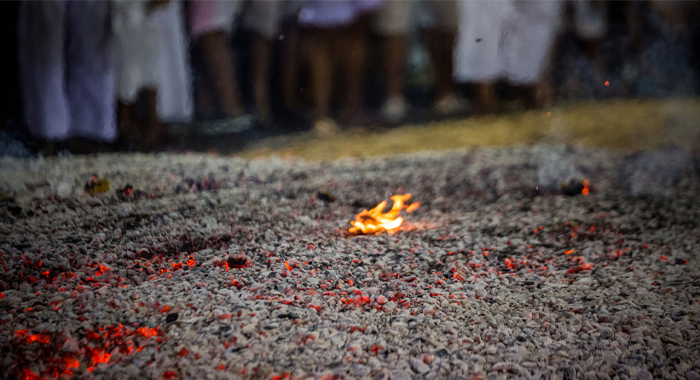
KR: I went to New York to do the fire walk with Tony Robbins [author and motivational speaker]. At the beginning of the fire walk process, they brought us outside where they were burning two cords of wood and we did a mingling process. People were face-to-face and each listened to their partner complete the same sentence. Then we moved on to a different person to do the same thing again. The sentence I had to complete was, “The thing I’m most afraid of is . . .” And at that time, the thing I was most afraid of was not getting a paycheck every two weeks. It was a terrifying concept. And by the end of the fire walk, I knew I could do it. I could go to Rolfing school. I could not have a paycheck. I could make a business for myself. And I’ve had a successful career for myself without being someone else’s employee.
MC: You actually walked on fire?
KR: Yup. Twelve feet. Me and five hundred other people. It was an interesting weekend. Yes.
Becoming a Rolfer
MC: Fantastic. What year did you go to do the training in Boulder, Colorado?
KR: I was going to do a workshop in Estes Park, Colorado, and I stopped at the then Rolf Institute to just check it out. Susan Melchior was part of running the office and she was a fabulous saleswoman. She had my name on the dotted line in twenty minutes. I agreed to take the class of the new comprehensive format of their program, which is now called Unit I (or Phase I). At the time, it was a six-week course, with four months of home study afterward, and a week together as a follow-up after that.
The course was in Marin County, California, near San Francisco, by Jason Mixter (1945-2009) and Rita Malette (1932-2019). Since I was still employed in New Orleans, I used the three weeks of vacation I would typically have. For the other three weeks, I was in class Monday to Friday in Marin County, and since I worked shift work, I would fly from San Francisco to New Orleans, drive home, get up at four o’clock in the morning, and go to work for a twelve-hour shift on Saturday and Sunday. Sunday, I’d leave work, get back on the airplane, and fly back to San Francisco for class on Monday. I commuted like that at first, then I had my three weeks vacation, and when the follow-up week happened, I think that’s when I gave notice at work and quit. That was 1987.
Then I moved to North Carolina, and I returned to the Rolf Institute to continue my studies. At that time, it was called auditing. I remember it was winter in Colorado during my auditing phase because I remember throwing a snowball at one of my classmates. Then I waited, I took the whole summer off, and completed my practitioning phase in the fall in San Francisco – that was a special class taught by Neal Powers and Robert Schleip. I was certified as a Rolfer in November of 1988.
MC: Did you start your Rolfing practice right after that?
KR: Yes, I had moved to Greensboro, North Carolina. I immediately came home, got married, and started my business. Back then, I didn’t have to get a massage license. I just put my sign up and said I was working. I had a table that I had bought from a beauty parlor.
MC: You told me at one point that when you moved to North Carolina, there were no other Rolfers around, so you had allotted two hours per client because you were trying to figure out how to do things on your own.
KR: There were two Rolfers around. One was Bob O’Rednik, who has passed now, and there was a local guy in Greensboro. He told me I’d never be able to get a practice started here, that it wouldn’t work. He said nobody would pay $55 for an hour Rolfing session. I had been paying $60 for my sessions at the time, so when I started, I was charging $60.
Practice Building
MC: Once you opened your doors, how did you get your first clients? I feel like Rolfing Structural Integration is still not well known in our area.
KR: That will be forever that some people will not have heard of this work, but it is much more well-known now than it was then. I gave speeches. I passed out brochures. I left my business cards in places. I’m not much of a networker, so I didn’t do that very well or very much. I had a professional picture made of myself, which was a good idea.
MC: How long do you feel like it was before you were as busy as you wanted to be? How long before you were booked up?
KR: It took me five years to build a practice. My speeches led me to be featured in local newspaper articles. At that time, I saved articles that talked about Rolfing, I was constantly looking for things like that and letting people know about the work.
MC: What was your office like? Was it in your home or a professional building?
KR: I worked out of my house for the first four years of my practice. When we finally accumulated enough money to buy a place, and we bought where we’re living now, I pointed out to my husband that there was no office in it. With no room that I could use as an office, to which he said, “Rent a place like everybody else that is in business.”
To afford that transition, I gave more speeches. I would go talk to anybody, any group. You just need to build your practice one client at a time. My office situation evolved over time. I started renting half an office condo in the building we have our office in now. Eventually, I convinced the person I was renting from that he could work from home, leaving me the chance to buy the professional condo. I then had enough space to rent out to other practitioners. I’ve rented to chiropractors, massage therapists, and acupuncturists to fill the space.
Volunteering with the Board of Directors
MC: Tell me about how you came to be on the Rolf Institute’s Board of Directors. What do you remember about that time?
KR: Well, I skipped the first annual general meeting that first year I got certified and cried the entire weekend. So the next year, I went, and I went every year after that. One year, they announced that they had started the Rolfing research committee. I stayed at the meeting longer to find out what that was about, they shared the information about that new committee during the board of directors meeting. When I saw what the board meeting was like, I started going to the board meetings on my own after that, at my own expense. I was really interested in that work, and the board meetings were always right after the annual conference.
I think I went to each board meeting for three years before I finally ran for a position and then got elected. I think I was re-elected one time after that as well. We were faced with significant decisions. We fired the executive director and the three of us on the executive committee took over all the functions of the executive director for about four or five months.
MC: Were you in Boulder, Colorado full time then?
KR: No, I was doing that work from here [Greensboro, North Carolina]. I think we had email by then. I was in charge of service marks and finances, if I remember correctly. That was when I figured out that the service mark was being misused by us. I figured out what the actual correct usage of a service mark was and got the staff and the rest of the faculty and members to use it correctly. We came up with the first guidance for our group to correctly use the service mark and how to protect it.
The mistake we were making was using the word “Rolfing” as if it were a generic term for our work. Using the word “Rolfing” as a generic term could lead to others having it. I’m the one who saved the service mark from that fate; we just weren’t using it appropriately. I kept asking why were all these people around us doing Rolfing massage? They were wrongly calling themselves Rolfers and claiming their work to be Rolfing. Since it’s a protected service mark, legally others couldn’t use it. But the error of service mark owners using the work generically could lead to us losing that protection. People weren’t capitalizing it. They weren’t putting the registered service mark behind it.
You know that the word “Rolfing” is an adjective, right? It was being used as a noun and as a verb. When we say we got “Rolfed” or that we are “Rolfing” somebody – we are using it incorrectly.
MC: So you were behind protecting the trademark.
KR: Once we were protecting it properly, then we could report a misuse, and have the Institute send a letter to the person of interest. The problem was that everybody in the Rolf Institute was using the word inaccurately, which did open us up to lawsuits. Believe me, it was a big deal to get that correct, and I was the one that figured out how to get it right. I was the one that started insisting that we use the term correctly.
MC: That’s a big deal! I’d like to hear more about the annual conference you were talking about, it must have been great to go every year. The school doesn’t hold an annual conference in the same way anymore, when did that tradition end?
KR: I guess when we got too old. [Kathy laughs.] An annual conference was a great idea for that moment when we were just growing the profession. They were fabulous fun, really wonderful. We planned it to be a three-day workshop with panel discussions and breakout sessions. They were real conferences.
MC: How long until you went for the Advanced Training? What year did you take that training?
KR: That was 1991, I had to get dispensation to join that class. I had only been in practice for two years and ten months. The reason I was motivated was because Brian Hopkins had organized a North Carolina Advanced Training. We had Advanced Rolfing Instructors Jan Sultan and Jeffrey Maitland, [PhD (1943-2023)] come here to Durham for six weeks.
Advanced Rolfer John Schewe was a buddy of mind before we were both Rolfers, we had met in a Tai Chi class. And John came up and stayed with me and my husband, Doug, to also attend that training. He introduced me to Doug in the first place, they knew each other through their geology connection. John stayed with us and we drove to Durham every day together. We’re both such extroverts, it was five and a half weeks before we ran out of something to say. I’ll never forget those six weeks sitting in a car together.
MC: I feel really fortunate that you offered to employ me as a Rolfer and that is one of the reasons that I went and got the training. I didn’t have the faith in myself or the confidence to do it on my own. I knew I could do it with you around to teach me. You have great techniques and you’re very effective with everything – necks, ribs, knees, ankles, wrists, elbows, sacrum, and everything. How did you gain your confidence?
KR: I had to figure it out. I have a very high mechanical ability. I don’t know what topics clients in other places bring to their Rolfers, I wonder what other people hear from their clients. I’ve only ever had three clients walk in and say, “I think my structure needs to be improved.” The rest of them, over my thirty-five years of experience, came in with a complaint – my neck hurts, my back hurts, my leg hurts, and so on.
There was a massage therapist that damaged his knee dramatically in Winston-Salem who called me up. When I moved here, there were seven bodyworkers in town. That was the thing, being a bodyworker was a new profession. One of them had fallen and damaged his knee. He said he couldn’t walk, couldn’t work, couldn’t pay me, and couldn’t drive to me either. “Please come help me,” he asked, “Drive to Winston-Salem and work on my knee for me.” I said I’d do it if I could bring my anatomy book and look at it while working on the knee. Okay. So, I did that for about six or seven weeks in a row. Oh, I really worked on his knee. I believe he had been a client of mine already, but that memory stands out to me. You just do the best you can.
You’ve looked at my list of continuing education training that I’ve taken, I’ve done extensive coursework. I picked up little bits from here and there, I studied with osteopaths for many years. And you learn when you’re working on people. You feel stuff and eventually you start putting things together that work.
I’ll come right out and say that I’ve never been that kind of Rolfer that can see where the work needs to be. I can’t. But I can feel an entire body when I put my hands on it. That’s why I’m constantly telling people to relax their tongue, I can feel that their tongue is tight. If I tell a person to move their foot, it is because I can feel that the system will respond in a way that I want it to by making that one movement.
Studying with Rolfer Richard Rossiter was a huge increase in my understanding of how bodies work, I met him at an annual conference. I remember once we were watching Rolfer Gael Rosewood [formerly Gael Olgren] give a Continuum demonstration – this would have been sometime in the mid-1990s. She lay down on the floor and it looked like her bones dissolved. She became like this amoeba on the floor and all of us were drawn to look at this movement. I had never seen anything like that in my life. And then, all of a sudden, her skeleton reasserted itself, and she went into a big front-to-back undulation movement and then just stopped. Richard looked at her and said, “I need a cigarette.” [Kathy laughs.]
MC: What is Continuum? I’ve never heard of this.
KR: I didn’t tell you about Continuum Movement®? Oh, you need to learn about Continuum. It was developed by Emilie Conrad (1934-2014). It is a non-directed movement or a bodily directed movement. At the start of a Continuum class, everybody will start in the same position, usually lying down. And then in ten minutes, nobody’s in the same position anymore because people are following their innate sense of movement. Each person will be going one way or another because they have directed their attention internally with their breath. Then they are directed to let their body move the way it wants to move.
I noticed that every woman that I knew in the Rolf Institute that studied Continuum looked ten years younger than they were. I wanted to learn that. It’s a daily practice like yoga.
Guerrilla Rolfing
KR: Maybe we should talk about guerrilla Rolfing?
MC: Yes, guerrilla Rolfing. That’s your term for when someone comes in with a complaint but you are still doing a series with them to correct the problem.
KR: When people come to me with pain, if I don’t touch the part that they’re complaining about, they’re not going to be happy with that session. But I want to do a lot of other work with them, as well as work on the thing that’s hurting them. And the good thing is that Rolfing works. A ten-session series makes a huge difference in people’s bodies. As long as they have some sense that you’re also trying to fix what their complaint is, they’re okay with it.
I sold the ten-session series. Let’s talk about that reality. What do you do when someone calls you up and says, “I’ve heard about this Rolfing thing? There are ten sessions or something?” The truth is, they do not want to listen to your interpretation of what you do at all. They could care less. The correct answer to that question is, “What’s going on with you that you think I might be able to help?” And then you shut up and listen to them. They will tell you about their body, as much as you’re willing to listen to, and eventually, when you have heard enough, then you tell them if you think you can help them.
If the person tells you they’ve got fourteen rods in their back, pins and plates through their skull, there will be a limit as to how much you can help that person. But if, as they’re talking, you hear some details that you think are issues you think the Rolfing approach will help them, then at that point you say, “Yes, I think my Rolfing work can help you.” When they ask you where your office is located, then you know they’re visualizing coming to your office. They are sold, they are ready to book an appointment.
I tell people to come in for one session and see what they think about it. Do a First Hour with them, which is designed to help them and also inspire interest in the rest of the sessions. We need to impress them so much that they know this is something that they want. Sometimes it’s not until the end of the third session that I’m curious about if they are still interested in the work, and if so, then they should consider completing the whole series. At that point, they feel so good, of course they want to book the rest of it.
MC: When we organize the body in gravity, it does feel better.
KR: It does. The other thing worth mentioning is that I do a really long intake interview with my clients. We were trained that Dr. Rolf said trauma in people’s pasts was a cause of a lot of structural imbalances. Back then, it was emotional trauma that we were talking about when we said ‘trauma’. Now I think that physical trauma is also what generates a lot of imbalances in the body. So, I like to ask the client many questions about their body history. People will get animated talking about the time they slammed into a post when they were skiing or something like that. Sometimes I see the injury they described in the intake; I’ll feel it when I’m working on them. Sometimes the emotional trauma they spontaneously share is a part of some interaction with the table work we are doing together. That the work is processing it out of their body. You know, our hands learn when we are touching, you know?
When I think back on my career, I was selling the Ten Series. That’s definitely what I did.
Changes in Structural Integration
MC: Tell me what you think about how the profession has changed from when you first trained to now. Do you have an opinion about it?
KR: This work is legal now, legislated to be a distinct profession in many places. It’s regulated, and it has a bureaucracy. It’s harder to get into now. And, there’s lots of people doing it, and lots of information to learn from out there.
The reason I picked the Rolfing profession over going to massage school was because there was a price differential. Rolfers charge more for their work. Why would I want to go to massage school when I could go to Rolfing school, where their graduates are earning more?
I think we have positioned ourselves in the manual therapy profession at the top echelon of it. And the work is at the top of the marketplace because Rolfing Structural Integration is so effective. We have been able to stay there with our efforts.
Everybody’s doing fascial work now. No massage therapists work on muscles anymore. Everybody’s working on fascia. That’s what they say. But I really wonder, when they say, “I’m working on fascia.” Do they know what they actually mean? And, what is fascia anyway? I don’t even know if the experts have decided what it is.
You know that I like to tell people, when you touch a body, do you know what you can touch? Skin. You can touch skin. And other than that, the rest of it is feeling. You can feel through the skin, all the way down; you can feel the entire body through the skin. But, all you can touch is skin.
MC: I don’t think a great deal of medical practitioners realize how much fascia there is in the body and what a big role it plays. You can’t stand up without it. I don’t think fascia is appreciated for how powerful it is.
KR: One of the fun things that I remember from one of those workshops – I can’t remember which one – we cut one of those little bitty skinny muscles off of part of the chicken wing that has the two bones in it.
We put that piece on a cutting board, then got a couple of pokey sharp things and tried to figure out the fascia. We could cut it off the bone, and we could see the tendon. And when we kept poking at the fascia fibers of the tendon, we looked for where the muscle was. There is no attachment between the tendon and the muscle. It doesn’t attach. The tendon is a type of condensed connective tissue that is continuous with the connective tissue embedded within the muscle fibers.
Connective tissue, as it leaves the bone, and right along the edge to the next bone, it starts to fill up with little muscle cells in it, until you get to the middle of the muscle belly where it has a lot of muscle cells in it. And that connective tissue keeps going to where there are fewer muscle cells in it, it gets smaller and condensed into another tendon, and it is continuous with the next bone. You can see with your own eyes that it is continuous from one bone to the next. There’s no ‘muscle attachments’ to a tendon. That is not how the body works.
Every once in a while, I like to open Dr. Rolf’s book and I say to myself, “Okay, I’m going to reread this book” (1989). The first time I read it, I didn’t understand any of it, right? I have reread this book many times. These days, I get three paragraphs in, and there’s so many concepts right there in those few paragraphs, I fall asleep thinking about them. So I like to reread Dr. Rolf’s book about three paragraphs at a time these days. Just kind of thinking about it.
The Business of Rolfing Structural Integration
MC: You have treated thousands of people in your career, and you’ve been so effective with those people. You’ve been able to hire and mentor five other Rolfers, which many people don’t take on. So, to what would you attribute your success as a Rolfer?
KR: That my skill as a Rolfer is as good as my skill as a business person. And I just by chance happen to have a mind that understands business, how it works, the ebb and flow of money. And I understand hard work. I mean, seriously. I didn’t get home before eight o’clock for probably fifteen years. At one point, I took clients at eight o’clock in the morning and was doing two-hour sessions. My first appointment was at eight in the morning, and my last one was at six in the evening.
Now, in the early days, there was a lot of time in between, and I was still working out of my house, so I could go do the dishes or laundry. But when I got my own office, when I was there, if I didn’t have a client, there were lots of other things that always needed to be done. I’ve been in business for thirty-five years, and only three times have I looked around the office and said, “There’s nothing that needs to be done here.” Three times in thirty-five years. That’s what running a business is like.
MC: And you’re still offering some Rolfing sessions these days. After thirty-seven years of this work, what do you see yourself doing in the future? I know you finally scaled back a little. You’re semi-retired.
KR: I’ve been reducing the number of clients by one every year. It’s still good exercise. If I had known that becoming a Rolfer would mean I’d have beautiful arms in my seventies, I would have become one sooner. I didn’t know that. Delivering Rolfing sessions gives you beautiful arms. It does keep you strong. You stay strong.
MC: When you were full-time in the past, you were seeing thirty-five clients a week. Did you do that for a few years? How did you manage your work-life balance when being that productive?
KR: It wasn’t a good idea. At the time, I didn’t have any children at home. My daughter was living in New Orleans, Louisiana, with my ex-husband. I had no responsibilities. So yes, I worked like that. And my husband was starting his own business. So, why not? My work-life balance was work. That was it. And dance classes, or Tai Chi, or whatever I was taking at the time. I was always looking for something like that. I taught Tai Chi when I first moved here. Nobody in this town knew Tai Chi, maybe two people. I gave classes and workshops, and got some clients from that side of things.
MC: Now that you’re retiring, what are you planning to do in the future? Do you think you will work with some of your clients forever?
KR: Thirty-seven years and I’m only working with people that I’ve known for years. I do not take any new clients. I hope to help the clients I work with age as gracefully as they can, trying to do the same thing myself. Also, trying to have a good time. Now I’m working on work-life balance, which is why I’m only working twenty-six weeks a year.
MC: As we are at the end of our interview, what would you like to say to people that are new Rolfers? Any advice to give people just starting out?
KR: Yes, I’d say get a job with an older, more established Rolfer. [Kathy laughs.] Get a couple of years experience under your belt. You know, I would have no idea how to start a practice right now. All that stuff that I did years ago – putting out flyers, giving people cards, giving speeches, and teaching Tai Chi classes – all of that worked for me over time. At this point, I just try to do good work every day I do the work. I try to do something helpful for my clients and have a good time while I’m doing it.
MC: Kathy, thanks for talking with me for this article. You’ve made a huge difference in my life and the lives of many other people. I’m glad our readers know more about you, too.
KR: You’re welcome.
Author’s Note (Mandy Cheek): It has been my privilege to receive work from Kathy Rooney, to be mentored by her, and then to be employed by her for the last five years.
Mandy Cheek is a Certified Rolfer™ practicing in Greensboro, North Carolina. She has a background as a physical therapist assistant, and after searching for her own answers to persistent health concerns, she found Rolfing® Structural Integration to address her persistent pains the best. She enjoys many kinds of outdoor activities and sports, including softball, volleyball, swimming, and recently, yoga. She is also a singer and a music aficionado.
Kathy Rooney is a semi-retired Certified Advanced Rolfer and Rolf Movement® practitioner based in Greensboro, North Carolina.
Keywords
Rolfing Structural Integration; Rolfing training; tai chi; Continuum Movement; practice building; manual therapy; mentorship; business of Rolfing; Rolfing service mark; annual conference; work-life balance. ■
View all articles: Articles home
Share this article:


